Saturday, July 30, 2022
“I Was Told There’d Be Cake: Essays” by Sloane Crosley
Thursday, July 28, 2022
“The Martins” by David Foenkinos
It seemed really real. I like that.
Wednesday, July 27, 2022
“The Country Life” by Rachel Cusk
Sunday, July 24, 2022
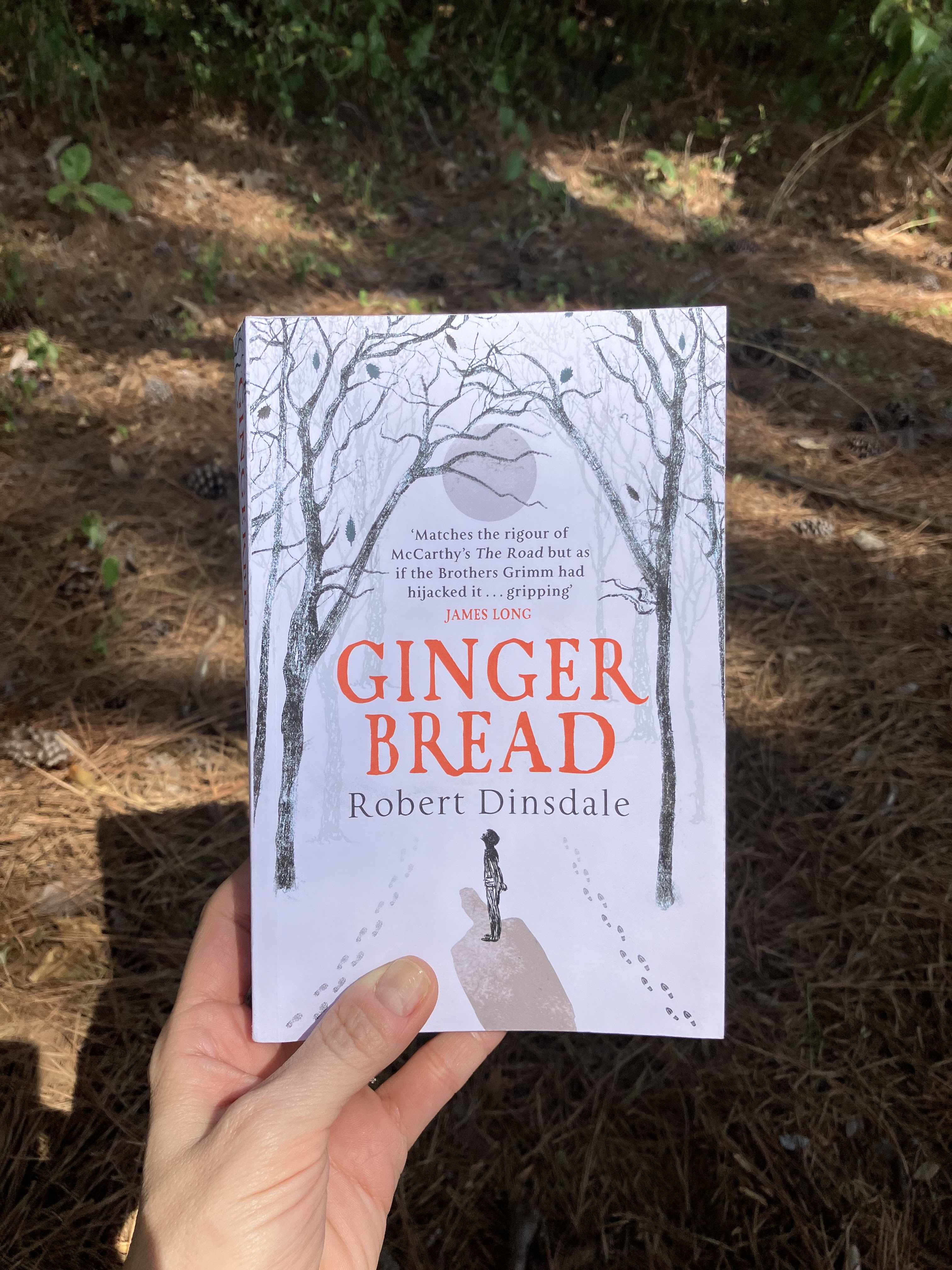
“Gingerbread” by Robert Dinsdale
So, yeah, it was slow going for me to start with, but I always intended to finish it. I just found myself reaching for a crossword puzzle more often than I reached for this book. But eventually I resigned myself to the cold and the dark and the hunger and the snow. And soon enough I found myself captured by the story. I was definitely rolling downhill with it during the second half.
This is the story of a young boy in Belarus who lives with his mother. He is not close to his papa, her father, but the boy and his mother must go to live with him in his tenement. The boy doesn't realize it yet, but his mother is dying of cancer, and he will need someone to take care of him afterwards--and, just as much, the boy will need to care for his papa.
Before he lived in the city, Papa used to live in a little house with Baba on the edge of the woods, and he takes the boy back there to see the place, but it is a rundown ruin. Even so, the woods are calling him back, and the boy and Papa move out of the city and into the forest. And the rest of the story teeters between fairytale and horror, with a number of well-known folk stories woven in.
Saturday, July 23, 2022
“Unsettled Ground” by Claire Fuller
The cover is not bad-looking, but unfortunately when I read the blurb on the back I found I was not interested in the premise of the story. However, I want to support independent bookstores, and it’s always nice to have a souvenir from a vacation, so I went ahead and bought the book, hoping that Fuller's amazing writing would bring me around.
Unfortunately it was not love at first chapter. As I got started reading, I found the characters boring, and everything was just so depressing and overwhelming. But I pushed on, because you know me. I can't not.
So I read and I read about middle-aged twins Julius and Jeanie, living in poverty with their mother. And I read and I read about their lives getting continually worse, even though everything was bad enough to start with.
But as I read, a funny thing happened. Before I was halfway through, I’d reached critical mass. It was still depressing and overwhelming, and I'm not sure I ever necessarily identified with Julius or Jeanie, but I did not want to stop reading. Claire Fuller has done it again, folks.
Sunday, July 10, 2022
“The Woman in the Library” by Sulari Gentill
So, meta. Are you ready? Sulari Gentill is an Australian crime fiction author writing the story of a bestselling Australian author named Hannah Tigone. Hannah is in the process of writing a murder mystery whose protagonist, Winifred (Freddie) Kincaid, is an Australian writer in residence at Harvard, having won the Sinclair scholarship. Freddie in turn is writing a murder mystery, based largely on life, since a writer for the student newspaper was found murdered in the library the day Freddie met her new friends Cain, Whit and Marigold. Freddie works on her novel while she is simultaneously consumed by trying to solve the murder (and subsequent dangerous events) with her friends. Meanwhile, Hannah sends every chapter she writes about Freddie to her American novelist friend Leo, and he responds to Hannah with helpful suggestions for improving the plot.
I didn’t love this book from the very beginning. (Was it only because the characters in Hannah’s book had such silly names? Surely not; this actually didn't bother me much because I was able to blame that on Hannah rather than Sulari.) It took me a surprisingly long time to get into. But I think by about 80 pages in, I was in. It may not be great literature or a classic for the generations, but it was clever and I enjoyed its shades of Only Murders in the Building, which is nothing if not fun. I liked puzzling through the whodunit of Freddie's life while simultaneously being creeped out by Leo's increasing helpfulness and insistence.
Monday, July 4, 2022
“Here in the Real World” by Sara Pennypacker
When I finally decided to read it, the first thing I noticed was “Ages 8-12” on the front flap. So that answered that question, while simultaneously lowering my expectations a bit.
This was a perfectly nice and enjoyable book to read, telling the story of eleven-year-old Ware who thinks he'll be spending the summer with his grandmother Big Deal. But when she falls and breaks both hips and faces a lengthy recovery, Ware has to go back home where both his parents are working double shifts all summer long. This means Ware is expected to spend his days at the crowded and noisy community rec center, which is not the favorite place of a daydreamy boy who prefers to spend time alone. But when he realizes the rec center is right next to an abandoned and half-destroyed church, and no one notices if he's at the rec center or not, a summer full of possibilities opens up to him (as well as to a girl named Jolene, who has also noticed the potential of the abandoned churchyard).
I probably would not re-read this book, but it was worth reading once, and I may hang onto it just because it's pretty and someday an eight- to twelve-year-old might want to borrow it from me.
Tuesday, June 28, 2022
“Bellman & Black” by Diane Setterfield
I fear that, for me, Bellman & Black fell prey to high expectations. I liked it. (It kills Sam to hear that.) I did not love it. I did not race through it. It did not consume me. Unless you count my absorption with hunting for what it was that Sam loved so much about it.
This is the story of William Bellman, beginning in childhood with a stone and a sling and a rook he never really meant to kill. Somehow that one careless act at the age of ten followed him throughout his entire life, from success to great loss and back again. But Bellman's story did not grab me, and while the writing was good and I can't point to any specific complaints, for some reason I just wasn't feeling it. And I'm more disappointed in myself than in the book!
Friday, June 10, 2022
“The Candy House” by Jennifer Egan
I really enjoyed this story. The overarching concept is that social media has been taken one step further: you can now upload your entire consciousness (including forgotten memories) and share it with whomever you choose. We hear about an entire range of reactions to this new technology: from those who created it to those who embrace it or shun it or are ambivalent. The title refers to that forest dwelling of a fairy tale witch: something that looks very tempting and draws you in, but then you're caught in something unexpected.
The writing was solid and the book was really engaging. There was, however, an underlying current of desperation or depression. Or maybe that's just this gloomy, rainy day talking?
Tuesday, May 31, 2022
“Five Tuesdays in Winter” by Lily King
This is a book of 10 unrelated short stories that showcase King’s range in their wide variation of characters and setting. Whereas typical short stories may be like a full novel in compressed form, most of these stories seem as if they could appear as a chapter in a novel. With the exception of the last story (“The Man at the Door”) they all feel vividly real; the last story is still vivid, but adds shades of the surreal. I love this sort of book, where the writing is impeccable and I can disappear into the story (or stories).
Friday, May 27, 2022
“Brood” by Jackie Polzin
How do you go about finding big, awesome, fun new books? Here was my method. I wrote a list of our favorite authors, then looked online to see if they had any new books out. Most of them did not, but the internet is nothing if not good for “if you like this, then you’ll like that” suggestions, and while I don’t specifically remember what led me to Brood, the internet was right. I liked it.
Polzin’s writing reminded me of several authors I’ve read (and enjoyed) recently. It was like Sarah Moss, or like Rachel Cusk (albeit without the intelligent and soul-baring conversations with strangers). It was like Nell Zink, but more The Wallcreeper than Nicotine. It was simple, calm and quiet, but also powerful.
Brood is narrated by a married woman with a flock of four chickens. (I have chickens, so this drew me to the book, but for Sam—who appreciates the eggs but not the hens—a storyline involving chickens was not a plus.) The chickens, and the narrator’s quest to keep them alive, are a major thread throughout the book, but other parts of her life (her relationships with her husband Percy, her mother, her best friend Helen, her non-existent children) are woven in as well.
Here are four random things I want to mention about this book.
1. I love its size. This is one of those smaller-than-usual books that fit so nicely in my hand.
2. All of the writing was great except at the very beginning. In the first three pages we are introduced to Helen, who asked such odd questions about the hens that the only explanation that made sense to me was that Helen must be a child. (She was not.) This, to me, was the only false step, which kept me outside of the story, but not for long. The rest of the writing was great.
3. This was not a funny book, but it made me laugh out loud at least three times. However, when I read these things aloud to Sam, he did not even crack a smile. Hm.
3a. One of these three things was about the raccoon with a briefcase. Percy prefaced the scene by saying, “You’re not going to believe this.” And he was right. I didn’t believe it. It must have been intended literally, since everything else in the book was as well, but it was a little too fantastic. Could it actually have happened to the author? If it didn’t actually happen, I can’t believe it would happen.
4. About 3/4 of the way through this book, the author bio caught my eye, and I saw that she has children. Sam says this was an overreaction on my part, but I almost felt betrayed, having assumed that the book was heavily autobiographical and thus that the author was as childless as the narrator. Looking at this in a positive light: I love when authors are able to make books seem so real that I believe they are real.
Sunday, May 22, 2022
“Notes on an Execution” by Danya Kukafka
And it was definitely a good choice! This is the story of Ansel Packer, abandoned by his parents at the age of 4 and raised in the foster system, who at age 17 goes through a brief stage of killing girls before settling down to a more acceptable existence with his future wife. The story leaps nimbly from death row to Ansel’s childhood and everything in between, told mostly from the perspective of Ansel’s mother and wife, plus the detective working the case of the murdered girls. While at times the story was unsettling, it was always very compelling.
Despite my enjoyment of the reading experience, I do have one complaint about the book. While I am aware that conventional wisdom disparages the use of adverbs in writing, surely this doesn’t mean we need to eschew them entirely? The first few times an adjective was conspicuously used where tradition indicated an adverb, it seemed quirky and experimental (in a good way), but the more often it happened, the more annoying and pretentious it seemed. Like, if it had only been done two or three times, it would have seemed like a positive, even impressive, thing. Or maybe if it was only used in relation to a single one of the narrators? But by the time I noticed it was happening every ten pages or so (fingers twitching nervous, dangling graceless, averted uncomfortable, the air tinged lavish…) the lack of ly was sticking out like a sore thumb and was definitely rubbing me the wrong way.
But that’s the worst thing (in fact, probably the only bad thing!) I have to say about this book.