I finished reading this book before I intended to. I was on what I assumed was the penultimate essay, a half dozen or so pages from the end, and I had just told myself that I would finish that essay and read the final one later, when poof, Acknowledgements. Not that this was unsurvivable. Just thought I would warn you ahead of time: the essays end on page 63. But no worries: the subsequent excerpt from Rundell's novel The Explorer is a treat.
Saturday, December 31, 2022
“Why You Should Read Children’s Books, Even Though You Are So Old and Wise” by Katherine Rundell
Thursday, December 29, 2022
“Little Nothing” by Marisa Silver
It was weird. In the style of a folk tale or legend, it tells the story of Pavla, born a dwarf (hence her nickname, Little Nothing) who has a beautiful face and golden hair. Pavla's parents are elderly, and they worry about how she will live after they die. Somehow they decide the best course of action is to get Pavla stretched to a normal height so that she can find a husband. The charlatan named Smetanka is actually able to do this stretching, thanks to an ingenious table-cum-torture device created by a resourceful young man named Danilo. The only problem is that Pavla ends up looking like a wolf girl, which kind of foils her parents' plans. Eventually Danilo and Pavla end up in a traveling carnival sideshow . . . and then Pavla kills and eats Smetanka and turns into a wolf. (That's almost 100 pages in, and probably counts as a huge spoiler, especially considering that it's not mentioned in the blurb, so I extend to you my deepest apologies. But I can't imagine how I can write about this book in such a way that I will remember it without mentioning the wolf thing.)
The rest of the story brings in murders and wolf cubs and prisons for the criminally insane (or just for criminals) and escapes and clockwork and digging tunnels for water pipes and, quietly in the background, war. The ending is quite ambiguous.
Monday, December 26, 2022
“What the Fact? Finding the Truth in All the Noise” by Dr Seema Yasmin

- Fake news isn't new--it's been around for years; when looking at journalism as a whole, it's also a lot less common and more nuanced than some people claim. (I'm looking at you, Smugly.)
- Fake news, as well as bad news, spreads much farther and faster than good news. This is generally because fake or bad news plays to peoples' emotions (typically those of outrage or fear), and people are more likely to share information that outrages or scares them--it's just human nature.
- People tend to believe what they're told first, and they are more likely to cling to these first-held beliefs, even if they're incorrect.
- There's a whole spectrum of "fake news," and almost all of it has at least a kernel of truth.
- Try not to be part of the problem--don't further the spread of fake news. For example: don't re-post information on Facebook if you don't verify it first.
- Take a good look at the news you are consuming, and its sources. You may want to expand your range of sources, even if only temporarily, in order to confirm the reliability or veracity of your usual sources.
- When appropriate, push back against people in your circle who are spreading fake news. Yasmin gives Ten Steps for Effective Disagreements, and this may be the most helpful part of the book:
- Pick your battles. It may make more sense to have a discussion with a family member than with the lady behind you in the line at the grocery store.
- Prepare for more than one chat. In most cases (see bullet point above, about people clinging to first-held beliefs) it's going to be difficult to impossible to change someone's mind; you're certainly not going to manage it over the course of one single conversation.
- Ask questions, then listen. If you think you're going to just give someone a lecture and change their mind, you're doomed to failure. You need to hear them out, and actually *hear* them rather than just using the time while they're speaking to plan your counterattack.
- Use the principle of charity. Don't assume the worst interpretation of someone's argument--instead of getting mired in thinking they are being illogical or selfish, try to see that they probably think their argument is as logical and strong as you think yours is.
- Ask for evidence. That statement may sound a bit like we're now going on the attack, but it may be phrased better if you say it this way: "What information and evidence did you use to form your point of view?" (I still think it would be hard to do this in a way that doesn't make the other person defensive.)
- Look for common ground. You may never agree on the big picture, but there are almost always aspects that can be agreed on.
- Don't shame people. You'll never change anyone's mind with shame; you'll only cause them to dig in deeper.
- Don't pour facts onto polarized conversations. Instead, you should focus on helping people to shift their perspective by . . .
- Harnessing the power of stories. This is actually something that fake news often includes--a story that tugs at your emotions--but the truth can spread more easily by playing on emotions as well.
- There is no one-size-fits-all approach. You don't have to use all ten of these strategies all the time. Different people or times or topics call for different methods (or different combinations of methods).
Friday, December 23, 2022
“Confidence Man” by Maggie Haberman
Monday, November 21, 2022
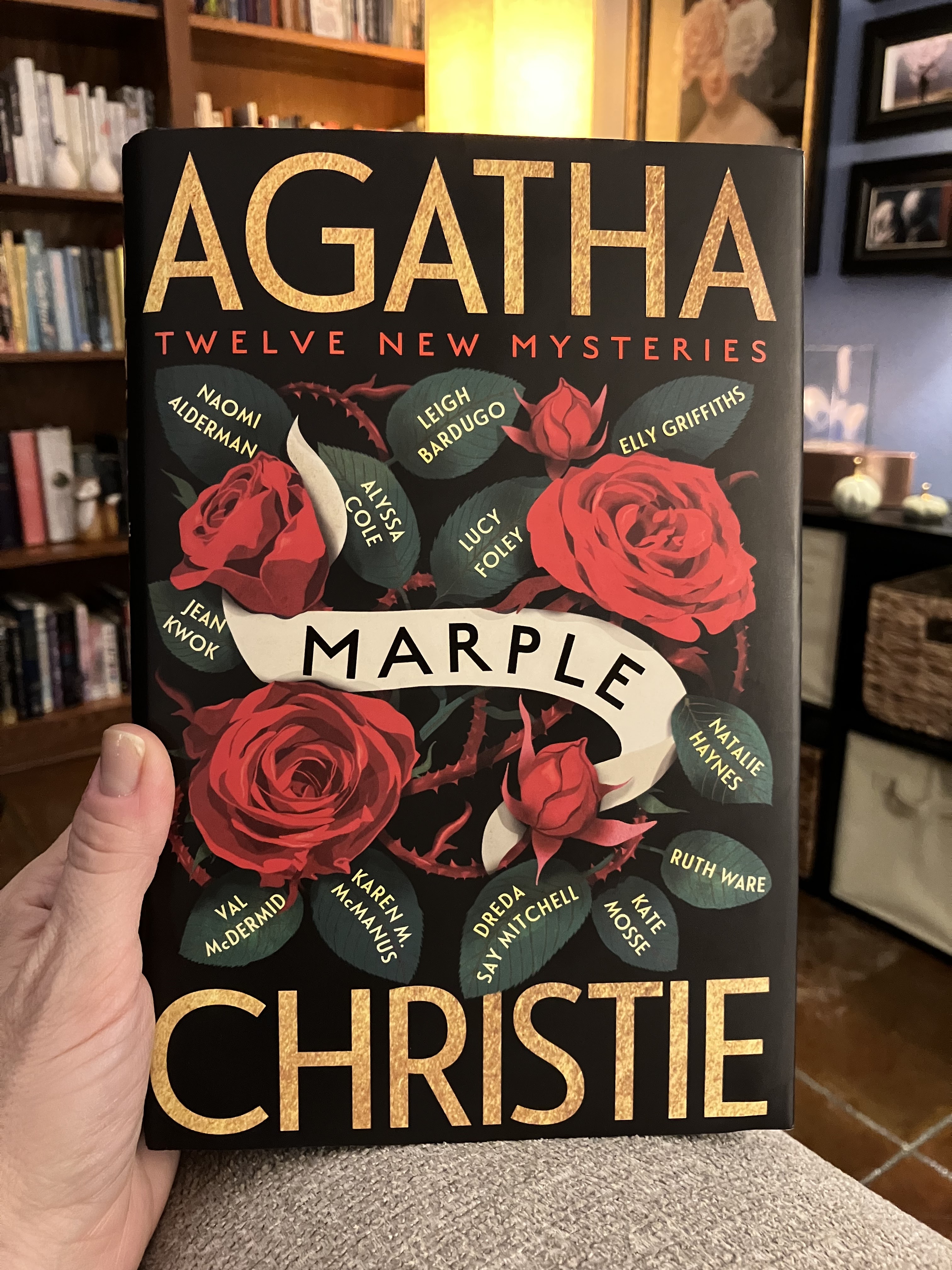
“Marple: Twelve New Agatha Christie mysteries”
Luckily the risk paid off! Each author did a great job channeling Christie. I was afraid they might go too far trying to “make it their own” but instead it seemed like each author’s goal was faithfulness to the original material. Sometimes so much so that each story appeared to mention the same things (nephew Raymond, a polite tipple, how constant human nature is) which had both the positive effect of making them seem like real Miss Marple stories and the negative effect of making me wonder if all the authors were told ahead of time which elements they were required to include. (This was ok, though, and did not dampen my enthusiasm for the book.) Besides, I’m sure Agatha Christie herself never wrote a Miss Marple story without mentioning human nature more than once!
Recently the short story format has worked so well for me, as it’s easy to dip into briefly whenever I have a moment. And it was fun to have something I was always so eager to pick up. Now I need to find something new to take its place!
Saturday, November 19, 2022
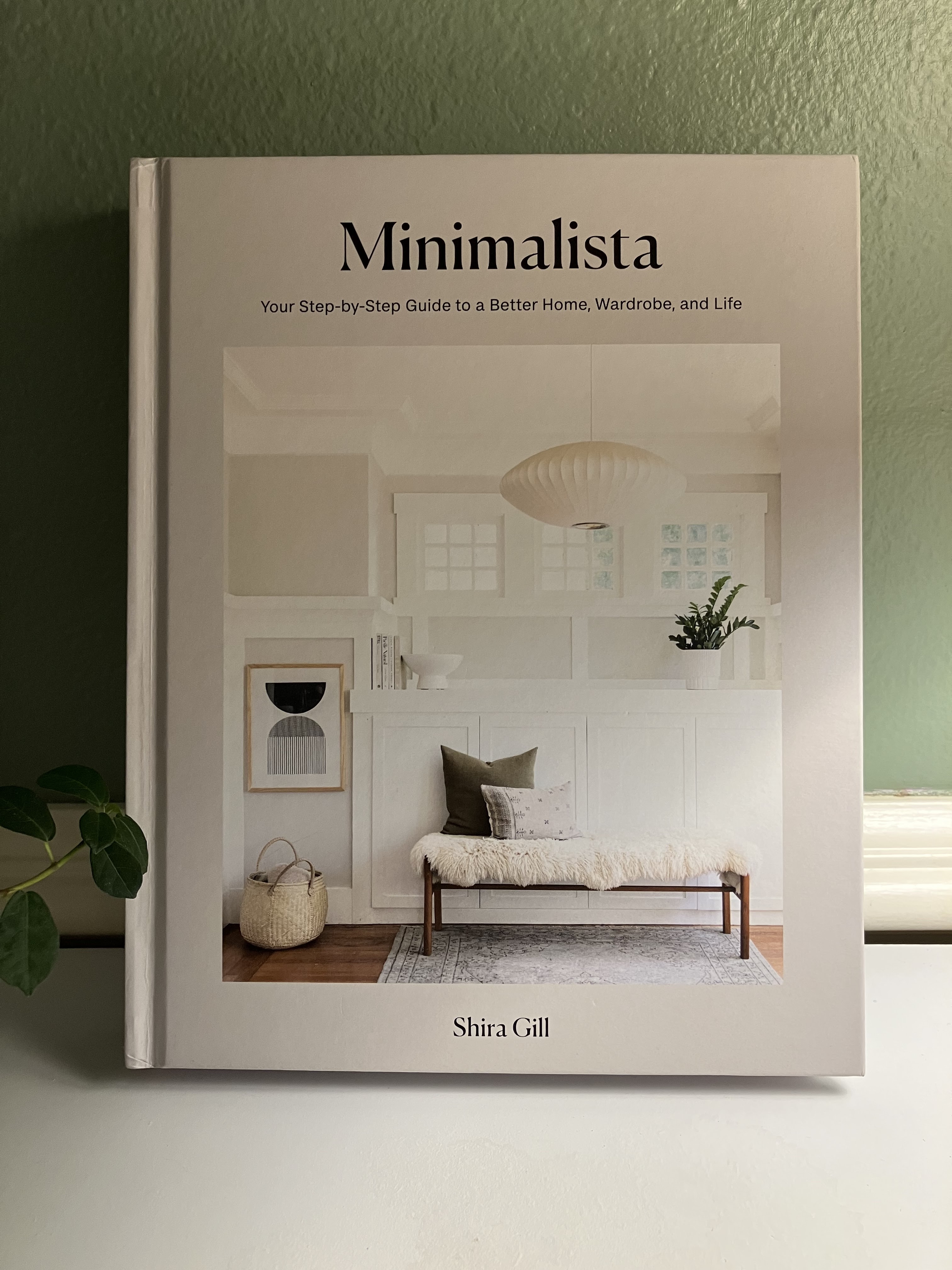
“Minimalista” by Shira Gill
1. What do I want to create a space for? Relaxing, reading, spending time with Sam (and, to a lesser extent, other relatives and friends)2. What do I want more of? Comfy cozy seating, beautiful light (natural or electric), warm blankets, squishy pillows, space to store books, beautiful things that draw my eye so that I can admire them3. What do I want less of? Clutter, chores, ugly things that draw my eye and make me think of the work I need to do4. What new results do I want to create in my life and home? Efficiency that allows me to maintain my home with minimal effort, allowing more of my time to be spent in relaxation and enjoying the beauty of my home5. What is my primary motivation for making a change right now? I have a beautiful new book to read. I want to spend more time enjoying life and less time doing chores.6. What is my most compelling why? Life is short, and I've lived half of it already. I want to make the most of the rest of it.
1. I find it hard to get rid of stuff that is mostly right but not exactly right2. I find it hard to FIND stuff that is exactly right, and I tend to accumulate a lot of contenders along the way. Sometimes I never find what I'm looking for and I merely gather possibilities. And then I feel guilty for getting rid of all those things I spent money on during the search (because inevitably I wait too long to decide whether to return them).
1. Would keeping this object help me meet my goals? Does it reflect and support my core values?2. Does it add value, or does it add clutter? Does it energize me, or drain me?3. Would it impact my daily life to not have this item? Would I want to take it with me if I moved?4. Is this item worth the space it takes up?5. Is there a legal reason to keep it? (insurance papers, receipts)6. Could this item be more useful to someone else?
While it was a fun idea to read something new, in the end I still prefer my old favorite home decorating book, The Inspired Room, (which I actually re-read--for the third or fourth time!!-- synchronously with this one). And really, before I had even gotten halfway through Minimalista I had already decided I would probably sell it at Half Price Books when I was done reading it. Maybe this is mostly because I found it odd that a book purportedly about minimalism seemed to repeatedly suggest that I go out and buy a bunch of new stuff. (What you have isn't exactly the right thing? Well, get rid of it and then go buy the right thing. I'm paraphrasing rather than quoting, but that's definitely the message I got, and that is NOT a message I need to hear.) Or maybe it was when, on page 209, I was asked, "could you or any member of your family quickly locate a lightbulb, a battery, a band-aid or a hammer?" and my answer was, Um, yes, yes, yes, and yes! giving me the feeling that this book was not for me.
Ultimately I realized . . . this book looks quite nice in the new Zen guest room! It fits the vibe. So my plans for its destiny changed, and that is where it now resides.
Friday, October 28, 2022
“The Divider” by Peter Baker and Susan Glasser
Tuesday, October 25, 2022
"Happy Orchid" by Sara Rittershausen
Unfortunately the majority of this book is composed of brief entries on many different varieties of orchids, and at this point I’m not really interested in expanding my collection beyond my easy-care moth orchids. But it was fun to look at all the pictures. The shapes and colors of these flowers get pretty wild.
I did take a few notes that may help, though (like, maybe I need to get some high potash fertilizer to encourage blooming). Hopefully sometime within the next month or so I’ll see a little baby flower stem poke out its tiny, pale green, mittened hand. Maybe there will even be more than one!
Saturday, September 17, 2022
“The Magician’s Assistant” by Ann Patchett
P38… this hasn’t grabbed me yet. But it’s Ann Patchett. I’ll keep going.
P299… how did I get so close to the end?
P357… The end? How could that be the end?? I hated the end. What a letdown. How anticlimactic.
Overall (like probably from pages 39 to 356) it was good. It was Ann Patchett and her writing is always brilliant. I can even forgive the ending. But this won’t rank among my favorites of hers. Although it’s possible it will surprise me and stick with me. Those were some pretty vivid characters.
This is the story of Sabine Parsifal, who has spent most of her adult life in unrequited love with the magician she assists. She is actually married to the magician, and he does love her in his own way, but for him the marriage is really only a way to make sure she can inherit his wealth after he dies, since he has no other family. (Although, as very few magicians can actually make a living by performing, Parsifal and his wife are financially supported by the two rug stores he owns and runs.) The story takes place very soon after Parsifal dies of an aneurysm (though if the aneurysm hadn't gotten him, the AIDS would have). And very soon after that, Sabine finds out that Parsifal's family didn't actually die in a car wreck decades ago. They're alive and well in Nebraska. (Well, most of them are, anyway.) What follows is an evocative account of the relationships formed between Sabine and her newly-discovered family members.
It seems like I ought to have a paragraph, or at least a sentence, to pithily wrap up this post, but I can't think of anything else to say, and really--how fitting if this review feels unfinished as it ends. Now you know how I feel.
Saturday, September 10, 2022
“Your Life Depends On It: What You Can Do To Make Better Choices About Your Health” by Talya Miron-Shatz, PhD
Saturday, September 3, 2022
“Our Endless Numbered Days” by Claire Fuller
Sunday, August 14, 2022
“How Did You Get This Number: Essays” by Sloane Crosley
Maybe if I’d read this book first, I would have loved it? (Or maybe I would never have sought out a second book by Crosley afterwards.) Each essay in Cake was so much fun. But comparatively, these essays seemed hurried, unfinished, unpolished. It was as if Crosley used up all her best material in the first book and then combed through the dregs and tried to mash them together to come up with a second book. I cruised through Cake, giddy and gleeful, giggling all the while, but more often than not in This Number my brow would crease slightly, I would stare off into the middle distance, and I would think, I do not think that means what I think it means. Then I would shrug and read on.
Harsh, I know. I always feel bad publicly baring my negative opinions of the work of living authors (and then I do it anyway… though it helps assuage my guilt to know that only fourteen people are going to read this). But on a more positive note: the last essay in the book, “Off the Back of a Truck,” was the best one. Not the funniest! It was too heartbreaking to be the funniest. But it was the best, telling the twin stories of how Sloane furnished her studio apartment by serial purchases of beautiful high-end items at cut-rate prices from a fat guy named Daryl even though she was pretty sure everything she bought from him was stolen, and how Sloane spent about a year dating handsome and attractive Ben who had assured her that he and Lauren had broken up, only to find out (from Lauren herself) that he had lied. Yeah, that story was a little depressing but it did have a subtle, gentle humor (most of which I caught, I think) and it definitely felt relatable.